After auditing hundreds of small business websites over the last decade, I’ve noticed a pattern: most SMBs aren’t failing because they don’t do SEO, in-fact, they’re failing because they’re following an outdated SEO playbook.
SEO can often be very frustrating for anyone who runs a website, especially when they’re not seeing the outcomes they desire for a particular website.
You will find several causes why your website could be performing poorly in search results, but certain SEO practices can hinder and in some cases destroy search rankings.
Failure to avoid them will definitely result into losing potential leads. So, here are 10 SEO mistakes to avoid on your website and solutions to fix them:
SEO Mistake 1: Not Using a Sitemap
A sitemap is a page that displays all the pages of your website and enables search engine’s ability to crawl through your content faster which improves visibility in search engine results.
This will ensure that you have better visibility in SERPs (search engine result pages).
These SEO mistakes for sitemaps are commonly ignored during initial SEO setup. Below is a real example where I fixed sitemaps and indexing issues for one of my client;
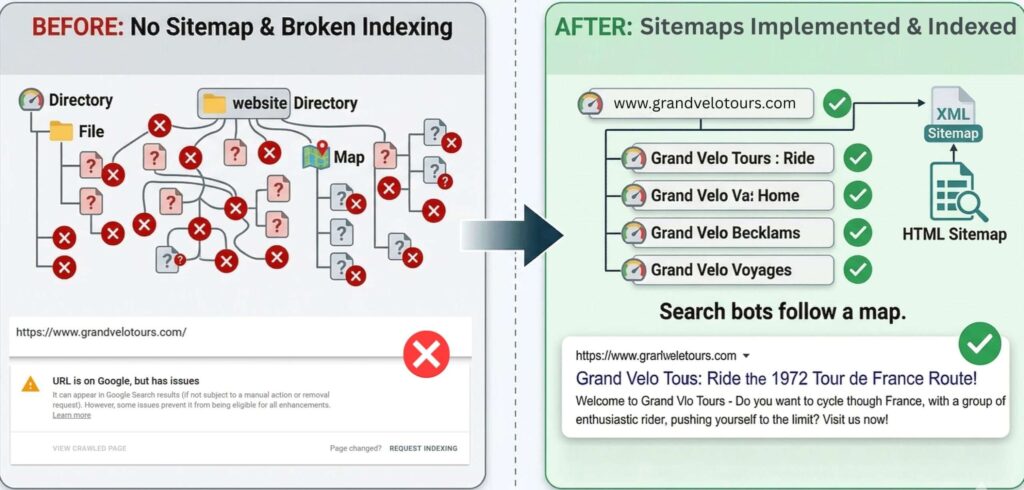
On the same context, your website content cannot be properly indexed by search engines if it lacks the HTML and XML sitemaps.
This means that there could be some parts of your website or even the entire web page which will not be reachable by the crawlers for crawling and indexing.
So, always use sitemaps for your website!
SEO Mistake 2: Not Checking for Broken Links
Broken links on your business website will lead a visitor to exit immediately from it without clicking anything.
In case there are visitors who encounter an error 404 message while surfing at one’s site, they will move away sometimes even if not necessarily.
So, it’s important to make sure that you check all of your links regularly.
To make this easy for myself, I use Semrush tool. It helps me keep updated with all the broken links within my website and even the external links as well. See below broken link report snapshot;

You’ll be sent an email of broken links if you use SEO tools like Semrush, SE Ranking or any similar one; thus enabling you to fix them quickly.
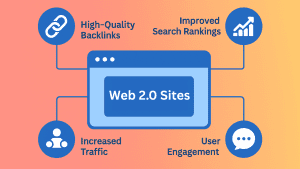
More importantly, you should not ignore these bad backlinks because they can cause major problems with your website’s SERP ranking, even, if they come from well respected sources.
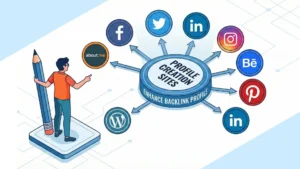
Generating backlinks is good, but keeping a sharp eye on important ones is far better. Consequently, you can use these local citations to build SEO backlinks.
SEO Mistake 3: Not Paying Attention to Your Anchor Text
If you are looking to improve your SEO, take note of how your anchor text (the clickable text) is written.
Keywords can be included in the anchor text to help direct traffic to a particular page or post within your business website.
Quality should always come before quantity when considering optimization of anchor text for search engines like Google or Bing. Over-optimization can ruin it completely.
So. try to use relevant variations in your anchor text while adding hyperlinks. – (In both, internal & external)
SEO Mistake 4: Not Using The Proper Keywords
For people who blog or write articles on their websites, they should know the exact terms that would enable their target audience easily locate them.
This is because you must know your audience as well as potential customers.
Rather than simply targeting the people you want to reach out to, also include those customers that might be interested in buying what you have.
Such keywords will be typed in the search bar on various search engines. By using these words in your posts, it helps in improving your content visibility thus more viewers are attracted to your website.
SEO Mistake 5: Opting Search Volume Over Search Intent
This is the biggest SEO blunder as compared to the mentioned ones in this entire post or even all of the SEO mistakes are being made around the world.
Many SEO practitioners target a keyword just because it has 10,000 monthly searches.
If you rank an informational blog post for a “Transactional” keyword (where the user wants to buy, not read), your bounce rate will skyrocket.
Here is The Fix: Align your content with the user’s goal. Are they looking to learn, to compare, or to buy? Simply, just fulfill the search intent.
SEO Mistake 6: Not Knowing Your Target Audience
Ensure you identify your targeted audience before you invest in SEO.
Remember, you cannot add value if you don’t know your target market. The truth is that not all individuals use search engines like Google or Bing.
That’s why it’s important to think out of the box and know about your audience whether you make them find your business on search engines or social media platforms.
SEO Mistake 7: Ignoring Mobile Users
Mobile search queries now account for 50% of all searches, surpassing desktop searches. If your website overlooks mobile users, it will face significant challenges.
Mobile-friendly websites improve satisfaction among users searching on their phones or tablets via search engines like Google, contributing to overall customer satisfaction.
Your products may be invisible to people searching on smartphones and tablets via search engines like Google, if no mobile SEO strategy is in place.
SEO Mistake 8: Neglecting Calls-to-Action
When you’re writing a blog post or a webpage content, do not forget to include a call-to-action. This can include anything from encouraging readers to leave comments on the post to buying stuff.
Alternatively, it may be asking people to click on up to reed a different content that gives them additional details or discount.
So, let there be at least one call-to-action in each web copy you produce.
SEO Mistake 9: Using AI Content Without Human Touch
Using AI to write your blogs is fine for a draft, but “unflavored” AI content lacks the Experience (the first ‘E’ in EEAT) that Google craves.
If a human hasn’t added personal insight, data or a unique opinion, it’s “thin content.”
Below is the real example when a D2C client approached me to fix the fully AI-generated content in all of the product pages. See below snapshot for AI-content fixes;
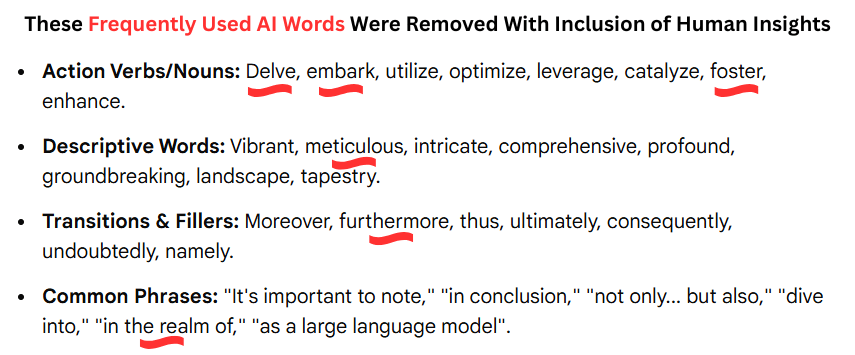
The Quick Fix: Always add a “Consultant’s Note” or a personal case study to your AI-generated drafts.
SEO Mistake 10: Ignoring Meta, Schema & Local Entities
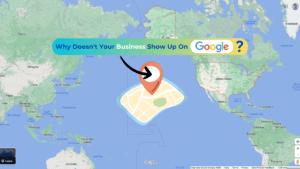
If you’re a small business based in Delhi but your website doesn’t explicitly reference local “entities” like specific landmarks, neighborhoods or regional industry terms then you are essentially invisible to high-intent local traffic.
It’s no longer enough to just say you provide “small business services”; you need to prove your local relevance to both humans and crawlers.
Here Are The Basic Fixes:
- Localized Meta Tags: Optimize your Meta Titles and Descriptions to include specific service areas (For example, in my case it will be “Top SEO Consultant in Delhi“).
- Local Business Schema: Use JSON-LD Schema markup to tell Google exactly where you are located, your operating hours, and your service area. This helps you land in the coveted “Map Pack.”
- GBP Sync: Ensure your Google Business Profile data (NAP: Name, Address, Phone) is 100% consistent with the footer of your website and external sites.
Conclusion
When it comes to SEO enhancements, there are a lot of things you can do to improve your website.
I hope these above curated seven blunders can probably help you get rid of these frequent SEO mistakes, if implemented correctly on your website.
Therefore, steer clear of these most common SEO errors and surely your website will gain more benefits from Google, Bing and Yahoo!
Have you made any of these 10 SEO mistakes in past? Let me know in the comments.